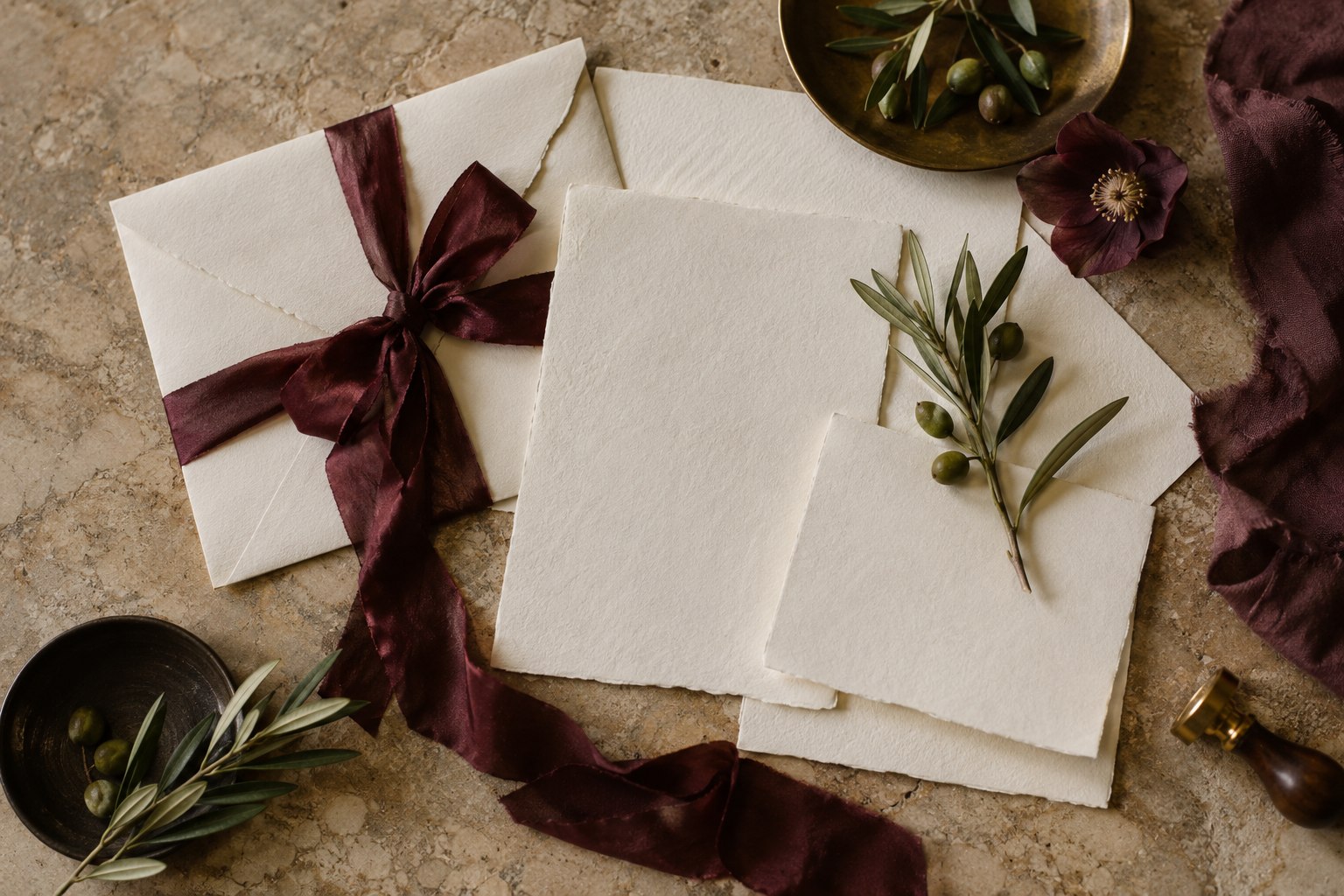
A wedding invitation has two jobs: make someone feel wanted and tell them exactly what they are being invited to. Beautiful paper cannot rescue a missing address, and formal language is not automatically more welcoming than a simple sentence. Start with the facts, then choose a voice that feels natural to you both. An invitation can be elegant without sounding like a document borrowed from another family.
This guide uses fictional names and dates to show how the pieces fit together. Treat the examples as starting points, not etiquette tests. Family structures, cultures, religious traditions and hosting arrangements differ. The best version acknowledges the people involved without making your guests decode a complicated explanation before they find the ceremony time.
Begin with the invitation’s practical skeleton
Write an unstyled draft before choosing typography. Include the couple’s names, the invitation itself, the date, the ceremony start time, the venue name and the location. Then decide where guests will find reception information and how they should respond. A separate details card or wedding website can hold travel instructions, but it should not be required to understand the basic invitation.
Read the draft as if you had never heard about the wedding. Would you know which Saturday, which building and which entrance to use? If the venue has a familiar nickname, give its official name too. Avoid listing only a city when there are several similarly named properties nearby. A small amount of precise information is kinder than a beautiful but ambiguous line.
Choose a hosting line that reflects your family
The opening can name parents, the couple, several families or nobody at all. “Together with their families” is useful when you want a shared welcome without assigning financial credit. “Amelia Morgan and Daniel Reed invite you to celebrate their marriage” is direct and works when the couple wants the invitation to speak in their own voice. Neither option requires an explanation of who paid for dinner.
If relatives have strong preferences, settle the wording before ordering printed pieces. Share a plain text version first so the discussion stays on names and meaning. Check spellings, titles and preferred forms of address individually. Avoid assuming that married guests share a surname. When a traditional format matters to your family, the Emily Post guide to formal wedding invitations offers a useful reference point.
Three original wording examples
With happy hearts, Amelia Morgan and Daniel Reed invite you to join them as they exchange vows on Saturday, the twelfth of June, at four in the afternoon. Willow House, Fairview. Dinner and dancing to follow.
This first version is warm and lightly formal. In a real invitation, add the year and enough location detail to identify the venue. Writing out the date is a stylistic choice; numerals can be easier to scan. Whatever you choose, use the same date and time everywhere, including your website, RSVP page and reminder messages.
Together with their families, Amelia and Daniel invite you to celebrate their wedding. Saturday, June 12, [year], 4:00 p.m. Willow House, [full address]. Please join us for a reception immediately afterward.
This version makes the family welcome explicit while keeping the logistics easy to read. Replace every bracketed field before printing. If the reception takes place elsewhere, name that location instead of saying “afterward” and expecting guests to find it independently.
We’re getting married, and we would love you there. Join Amelia and Daniel for vows, dinner and a very good dance floor. June 12, [year], at 4:00 p.m. Willow House, [full address].
A conversational invitation suits a relaxed celebration, but humor should never obscure the facts. Keep jokes away from RSVP instructions, dress requirements or anything guests might interpret literally.
Add warmth without borrowing somebody else’s voice
Think about how you invite friends to a meal. If you would never say “the honour of your presence” aloud, you do not need to use it on paper unless a ceremony tradition makes that wording meaningful. Choose one emotional note: joyful, intimate, celebratory or quietly affectionate. Mixing ornate language with several jokes can make the invitation feel assembled from unrelated examples.
For a wider range of openings, browse these wedding invitation greetings and messages, then rewrite the idea in your own words. Read the result to your partner. If either of you laughs because it sounds unlike you, simplify it. The invitation should introduce your celebration, not demonstrate how many romantic adjectives fit on one card.
Make the RSVP easy to complete
Choose a response method that suits your guests, and provide a workable alternative for anyone who cannot use it. A website may be convenient for most people; a phone contact can help relatives who do not use online forms. Set your response deadline by working backward from the caterer’s confirmed deadline, leaving time to follow up and resolve meal questions.
Say what a response needs to include: attendance, the names of invited guests and any requested meal choice. Ask about dietary needs in a neutral way, and send the information privately to the relevant provider. Avoid collecting unrelated personal details. If children or partners are invited selectively, address the invitation to the actual people included instead of relying on a vague household label.
Keep delicate details clear and considerate
An adults-only celebration needs consistent wording and direct conversations where necessary. A short details-card sentence such as “Our celebration is for the adults named on the invitation” is clearer than a poem that leaves parents guessing. The couple should agree on exceptions before invitations go out. Guests may decline because childcare is difficult, and a gracious response leaves room for that reality.
For a dress code, describe useful expectations rather than policing taste. Mention grass, gravel or outdoor temperatures when those details affect shoes and layers. Put accessibility contacts and arrival instructions somewhere easy to find. Registry information can live on a separate website page; the invitation itself should center the welcome rather than a request for gifts.
Proof the invitation in the format guests will receive
A phone preview does not show whether a printed address is too small. Print one copy at actual size and ask someone outside the planning process to read it. Check contrast, line breaks, spelling, date, year and venue details. Scan any QR code from the printed sample using more than one phone if possible. Include a readable web address so the code is not the only route.
Ask your stationer about envelopes, assembly and postage before committing to unusual shapes or heavy embellishments. Mailing requirements depend on the postal service and the finished piece, so verify them directly. Keep a final approved text file. If you later update a location or time, use that file to identify every place that needs correcting.
Send a useful reminder, not another invitation
Close to the wedding, a brief reminder can cover anything guests need for arrival: the entrance, parking arrangement, transport pickup point and weather-related changes. Do not silently replace an earlier ceremony time on the website. Send a direct message when an important detail changes, and ask a trusted person to reach guests who may not see email.
Once the wording is clear and the details are confirmed, stop polishing every adjective. Guests are coming to see you get married. A warm invitation that arrives with accurate information has already done its work. For the practical information that belongs beside it, continue with our guest arrival and parking guide.
A final invitation check
Compare the invitation against the venue confirmation one last time. Check the year as carefully as the day and month, especially if you adapted an old sample. Read telephone numbers and web addresses character by character. Keep one assembled invitation for your own records, including every insert, so you know exactly what guests received when a question arrives later.